
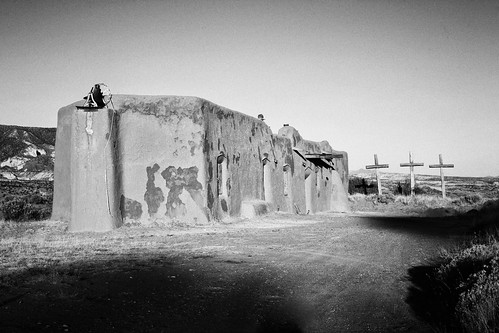
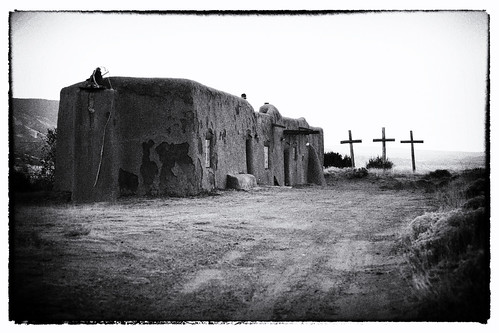
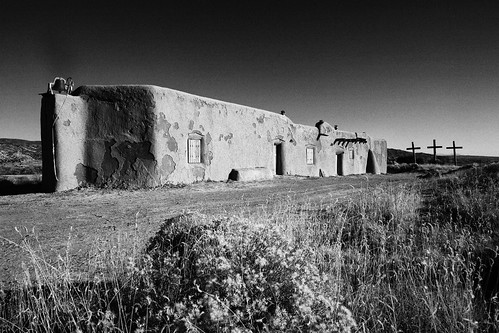
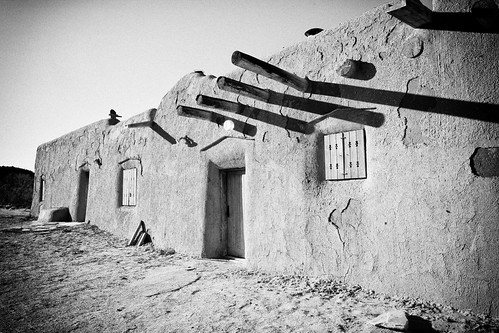
On a cliff in New Mexico stands the reason I could die and not regret having never seen Paris, or gasp, Italy. The structure is not in guidebooks; its presence on the internet limited. The wonder of it on this trip, a simple road trip on borrowed time, summarizes what travel should be – a serendipitous discovery of the unknown. I’d only heard of it from those who’d heard of it. A small shotgun structure built in the 1700s of straw and mud, the soft curves formed by hand, the large bell at one end tethered to a frayed rope, neither it nor what transpires inside has been altered much by time. Standing respectfully behind the fence with evening bearing down I walked back and forth admiring its position on the hill, the three silhoutted crosses shifted in sand until they’d settled into their own quirky angles, the perfection of the clouds, the angles and time of day at which I’d want to photograph it…. Intent to absorb and appreciate the drama of the moment without a camera in hand, an ineffable joy at seeing this with my own eyes created unexpected tears. I didn’t know then that the next evening I’d be inside the structure, part of a service a rare few have seen.
Abiquiu is known more as a general area in northern New Mexico. But there is an actual town – a private, protected tiny gathering of people tucked into the cliffs of the area; some families having lived here for generations. Like the hollers of West Virginia, the inhabitants live in precariously perched houses helter skelter among the cliffs. It reminded me a bit of Kashgar’s Old Town in China’s Xingiang Provence – New Mexican style. As I crept the truck up the narrow dirt road leading into town, a level area in the cliffs spread out suddenly into a large flat courtyard of sorts. The original villagers had planned the space well – a large adobe church anchored the community and provided a buffer between the outside world and the private dwellings on the other side. At every turn of the tires I felt an unease and wondered if I weren’t treading on private property – there were no signs. The town was hushed and felt deserted but as I crept through the funnel of walls just past the church, I saw activity at one house – maybe a general store. I went inside to test my resolve to ask about the morada and discovered it the town library. Smack in the middle of town with the only human movement, was the library. Impressive. I inquired about the “church” I’d heard of. You must be asking about the morada, a lady said. “It’s past the wall and up the hill.” None of the roads looked Yukon passable. They looked like private driveways, river fingers breaking free just past the courtyard. “And there’s no photography.” “Is it ever possible to photograph it?” “Yes with the permission of Brother Ralph.” We went back and forth until I’d written my name and where I was staying on a sheet of paper and she’d promised to call him and have him call me.
Standing there with grit gathering like a party on my wet cheeks, the library Director’s business card fell out of my pocket. By the time I’d chased and trompled it with a boot then placed it in a safer spot, dark had overtaken the hill; the morada tucked into shadow, lights for dinner beginning to twinkle from the houses not visible during the day. I headed to the Inn for a bit of research and hopefully a call from Brother Ralph.
Penitente is Spanish for one who does penance. And morada (Spanish for abode) is where they meet. Just beyond the basics things get interesting. The Penitente are an extension of the ancient Hermandad (Spanish for brotherhood). If you look to the history of medieval Spain, Castile specifically, you find they were an association of armed individuals that kept the peace in rural communities with the roots of the Los Penitentes dating back over a thousand years. Closer to home, the current incarnation of the Penitente Brotherhood springs from Mexico’s independence from Spain in 1821. Catholic authorities withdrew the Franciscan, Dominican and Jesuit missionaries from Mexico and replaced them with secular priests; but not one-for-one, which left small communities without a resident clergyman. Without a priest, men of these communities formed the Brotherhood for the purpose of prayer and spiritual and social aid. A central organization never coalesced because the communities were so isolated and far apart. A hermano mayor (elder brother) is elected head of the individual group of men. The Brotherhood from the beginning was fond of flagellation as a means to cleanse their sins (all the way back to ancient Spain). The Church, in the late 19th century attempted to stop what they called “archaic and heretical behavior”. The Brotherhood said “you’ve left us to our own devices and to fend for our communities’ spiritual and social needs the best we could all these years and now you want to tell us how to do it?!” And then they went underground earning the ever intriguing “secret society” moniker. It all ended well in 1947 when the Los Penitentes received formal recognition from the Church. They remain active in northern New Mexico and southern Colorado. They are however still somewhat of a secret, representing isolated communities, meeting in ancient moradas way off the beaten path.
Well after dark the next evening, I drive the truck slowly to the top of the hill. This morado, built in the 1700’s and most definitely a secret meeting site at one time, is dimly lit on the exterior from a few modern solar ground lights. But the frigid New Mexico sky holds sparklers tonight – the way is well-lit. Stepping up and over a threshold, I can’t see much in the dimness, but a blast of scorching wood heat thumps me in the face. The runner room was nine feet wide and maybe 20 feet long with a worn wooden bench running partially down each side – we faced each other rather than facing the front. The floor was the kneeler. Tiny windows shuttered tightly. It was old and immaculate. Walls were a slick shiny creamy white – like a coating of candy. A low wattage lightbulb was strung to the side of the alcove aglow with candles. There were seven men and an older woman who had already begun prayer. Their quiet reverent whispers and the crackle of the wood were the only sounds. I took a place at the end of the bench nearest the door but right across from the chugging wood stove. I’d just have to die of a heat stroke. At least I was in a good place. Ralph comes to me and shakes my hand, smiles at me. I already had tears. And they weren’t from the heat. I watched and listened and followed suit and observed that the men’s boots were dirty and worn – my own hiking boots blended nicely. Working men. Hard working men. Kind men. Gentle to the core. I was thankful I knew enough about a Catholic service to not stand in line for sacrament. And then it was over. Into a tiny room with a burning kiva at the end of the morado opposite the sanctuary they invited me to duck and enter for cookies and cold drinks. And in there I met the men, one of their mother’s (a guest as well), and heard some about them and a little about the Brotherhood. A strong sense of community and possibly a bit of mysticism impressed me. They requested one of my photographs of the exterior. Invited me back. Hugged me. And in that tiny, dim, ancient, God filled castle room, all travel regrets were washed away like sins. Those too.
All names have been changed. And the deal for photography was strictly “non-commercial.” Which is why there aren’t any advertisers on here. The good stuff can’t be bought.
Other New Mexico related posts in this series:
Abiquiu – The Penitente Morada
Abiquiu – The Dar al Islam Mosque
The Green Chile Cheeseburger Trail
New Mexico Travel Sites:
Hatch Chile Festival – September 3,4, 2011
I was spellbound by your story. I was right alongside you as you experienced it…you took us there. Thank you, Thank you so very much for sharing. I would love to come visit someday. Look forward to more of your adventures.
Comment by Yolanda Flanagan — January 14, 2018 @ 1:31 am
I also stumbled (or was I guided to?) upon this posting – and am grateful for it. As one who is blessed to be both Pueblo Indian and Hispanic, embracing and living fully both aspects of my identity, I commend you for the deep respect you show in this piece. But it goes beyond respect – I believe that what you experienced that night is what mystics and seekers of every age, time and place have so earnestly sought since time immemorial. You witnessed and were touched yourself by the Divine – the Great Mystery revealed to the depths of your very being. And you surely came away both grateful and changed in some way by this singular event in your life. The simplicity and beauty of your story matches perfectly the simplicity and beauty of the people and place that is our beloved New Mexico. I pray that in times of turmoil, doubt, or wretched desperation you can look back on that night and draw from it again the strength to carry on, always walking in beauty and peace.
Comment by Armida Hernandez — July 30, 2016 @ 11:40 am
I am glad I found your website. I am from Abiquiu and this Morada is one of two in Abiquiu if you did not know. We have this one, which is called the morada del pueblo, and the other is the morada del Moque.
I always love hearing about my home from an outside perspective, it helps me remember how special it is and how lucky I am to be from such a beautiful place.
My family has been in Abiquiu for a few hundred years and includes the earliest Spanish settlers and the natives who made up the pueblo before the Spanish settled. Unfortunately we are a people without a tribe so we hold onto our native roots through songs and rituals done in the moradas.
Comment by Daniel Archuleta — April 14, 2015 @ 1:37 am
I just came from a Morada in San Mateo NM….I never knew what it was…I took numerous pictures and heard the story as told by towns people…it is a very holy place and u can feel a heaviness…i would love to be able to see it at some time… I believe I would cry..
Comment by Stacey Madrid — March 24, 2015 @ 1:08 pm
I have been to this haunting place. I was overwhelmed and moved to tears by the spirituality and beauty of this simple structure. You were indeed privileged to be invited to share in the service.
Comment by Sue Ellen — August 26, 2012 @ 5:07 pm
I just visited Abiquiú a couple of days ago and was doing some research on the internet about the Penitente Morada and found your blog. I really enjoyed reading your story. Thank you for sharing it. I look forward to reading more.
Comment by Michele — August 13, 2011 @ 9:58 am
It is so true that the good stuff can’t be bought. What a great moment of discovery! I feel the sense of it in your words and get the impression of the place in your wonderful pictures. Well done!
Comment by Pops — April 25, 2011 @ 9:25 pm
Oh, how I loved this story! I felt the heat of the wood stove on my face and felt God in that tiny place. What marvelous adventures you have. Thank you for sharing with us!
Comment by claymama — April 25, 2011 @ 8:59 pm